Now that the hulls are assembled they won't fit back into the basement any more. It's been ok to keep them outside so far but the sunshine won't last forever so we are moving up the fiber glassing job to protect them while they are out in the weather.
The paint job looks a bit messy up on the saw horses but all those areas won't show.
All the stitches are out and the keel has been rounded over so we can put a piece of glass tape along the keel joint. This area is going to get the most abuse pulling the boat up on beaches so it gets a triple layering of fiberglass. The first layer is this tape and then the two side pieces will overlap over keel as well. We also put a bead of epoxy down to build up the radius and add more protection to the wooden keel strip.
Next we unrolled the 4oz fiberglass over the size of the hull and tacked it in place some epoxy where we couldn't hold it with tape.
Then we finally got down to spreading on the epoxy. We had been dreading the fiber glassing job and what would happen if we messed it up but it really wasn't that bad.
The fiberglass cloth does want to wrinkle as it laps over the curved edge of the keel but we kept at it and got all the wrinkles spread out.
The fiberglass also wraps up onto the skeg and smooths out the transition. This area is probably going to require some filler and sanding later but is looking pretty good.
We also had to notch the cloth around the lash pad supports. We ended up just glassing down to the edge and trimming with a razor blade which made a pretty clean edge.
Then we just had to keep moving back between the two hull as each fiberglass job cured.
Showing posts with label Lashing Pads. Show all posts
Wednesday, August 8, 2012
Saturday, November 26, 2011
Gluing the bow pieces
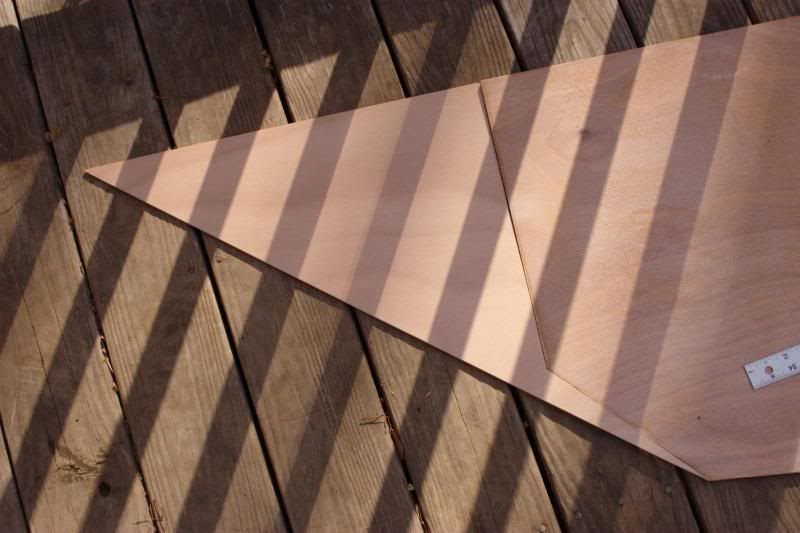
The final component of the hull panels is gluing on our funky shaped bow piece.
These glue on with butt blocks just like the joint in two main panels. We didn't glue the joint along the point because we couldn't come up with a good way to clamp it. After the main joint is cured everything should be held in place enough that we can get at the remaining edge joint.
Since the hull sides were out and we were mixing up glue anyway, we moved on to cutting the backing pads for the lashing connections between the hulls and cross beams. These are glued to the inside of hulls and support the lashing pad bolts.
Glued in place with a small fillet except where the bulkhead will sit flush along one edge. These were pressed in place and stapled from the under side which proved to be adequate for holding them in place.
Here are all four hull panels assembled with backing pads glued on lounging in the sun. Just add sheer stringers and these are ready to stitch!
Tuesday, August 30, 2011
Cutting stems and rudders
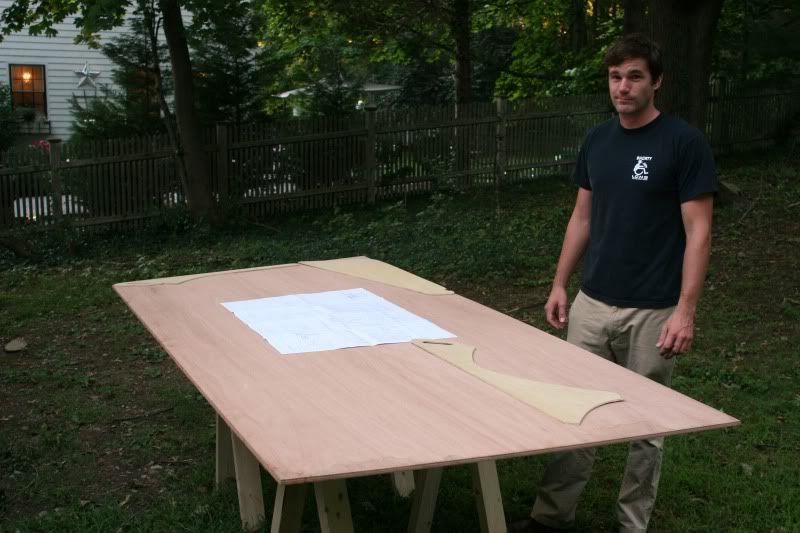
Time to keep this project moving. One of the many tasks between us and stitching up the hull sides is cutting out the stems and rudders. Having learned our lesson cutting out the 4mm panels, we layed out all the templates carefully to conserve as much space as possible and followed the plans exactly. Smile for the camera, Cam.
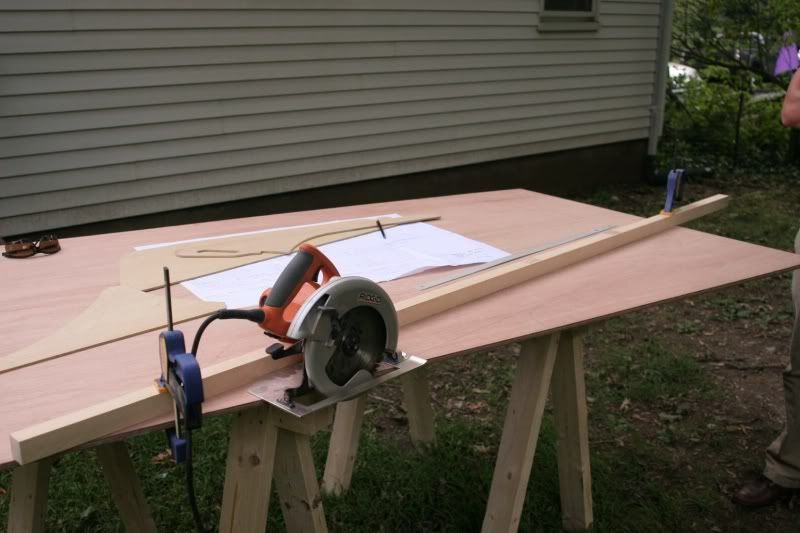
Hopefully that means we won't have any trouble in the future. Next we used a scrap board with a nice straight edge as a guide for the circular saw to put as clean a cut as possible on the rudder to stem edge while we cut it.
We used the same technique to cut the long edges of all four stems and both rudders. Next we cut out a rectangle that will become the backing pads for the beam lashing points. Had to double check the math to make sure we allowed for the right number of saw kerf widths but it should be just right. Next time the table saw is out we can rip it down to final width and then cut it up into our blocks.
I'd be nice to have everything ready to stitch at the end of the weekend. Not sure if that is doable but it's a nice goal.
Hopefully that means we won't have any trouble in the future. Next we used a scrap board with a nice straight edge as a guide for the circular saw to put as clean a cut as possible on the rudder to stem edge while we cut it.
We used the same technique to cut the long edges of all four stems and both rudders. Next we cut out a rectangle that will become the backing pads for the beam lashing points. Had to double check the math to make sure we allowed for the right number of saw kerf widths but it should be just right. Next time the table saw is out we can rip it down to final width and then cut it up into our blocks.
I'd be nice to have everything ready to stitch at the end of the weekend. Not sure if that is doable but it's a nice goal.
Subscribe to:
Posts (Atom)